nikam.dev ← All cases Telegram →
Live · EdTech · ages 7-18

Kids build real games with AI - and walk away with their own tool: our site is no longer needed.

A free school where a child from age 7 builds a working game and publishes it on a link. Three stages by age: the youngest assemble a game by tapping pictures, the middle ones describe it in words and edit files by hand, the oldest work in a grown-up tool - their own repository, tests and server. 84 steps, and every step of the two older stages has a second way through: a visual novel with backgrounds, character emotions and choices - same material, different form, for kids who don't read. And the novel can also be listened to: all 2,829 lines of the course are voiced, 4.6 hours of speech. The check is not a memory test but an acceptance: you built it, now show it. Five open starter projects on GitHub, each with a gate that catches the errors the engine stays silent about. Completely free, no ads, no personal data about the child - only a nickname they made up.

What
A school for building games with AI
For
Ages 7-18, three stages
Scope
84 steps · 78 novel chapters · 4.6 h of narration
Status
Live · free · in Russian
- The problem

Kids are taught to prompt. That's not a skill, that's a habit.

A 'programming with AI' course usually works like this: copy the prompt, get the result, move on. There's a game, there's no understanding - and the first thing that breaks ends the story, because there's nothing to fix: none of it was ever theirs.

Pain 01
There's a result, there's no understanding
The child copied a prompt and got a working game. Ask why the character falls faster and there's no answer. The moment something has to be changed rather than repeated, the story ends: changing things is not something they can do, because they never have.
Pain 02
Locked to a platform instead of a skill
The builder works as long as the course site is open. Close it and the child can do nothing: not start a project, not save a version, not put it online. The course ended, and with it everything they supposedly 'could do'.
Pain 03
They don't read, so they don't learn
Some kids simply don't read text. A course made of walls of words loses them by the second lesson, and it isn't about ability: the form didn't fit the person, and no other form was offered.
Pain 04
Memory gets tested, the result doesn't
A quiz at the end of a lesson shows the child remembered some words. It says nothing about whether what they built actually works - and that is the only thing that matters.

Three stages, three ways through a step, and a live link at the end.

Not a video course but a method: a short 2-4 minute step, then practice, then a check of the result. It all runs live on school.nikam.dev - in the browser and as an app inside Telegram.

A stage per age, not one course for everyone
At 7 and at 15 different things get in the way. The youngest assemble a game by tapping pictures - no typing at all. The middle ones describe the game in words and learn to edit files by hand. The oldest work in an ordinary grown-up tool: their own repository, tests, server.
The same step can be played instead of read - or listened to
Every step of the two older stages has a visual-novel mode: 78 chapters with backgrounds, character emotions and choices. And the novel can be listened to - all 2,829 lines of the course are voiced, 4.6 hours. A child who struggles with text still has two doors left, and progress is shared: how you go through it is a matter of taste. I haven't seen this in any course for kids.
An acceptance instead of a quiz
To publish a game built with AI you have to change at least two things in it yourself and answer how it works. Until you do, the button doesn't work. Not persuasion - a button that simply isn't clickable yet.
Five open starters with gates
Minecraft, Roblox, Godot, a Telegram game and a web arcade - on GitHub under MIT. Each carries a check for the specific trouble its engine stays silent about. The child hits 'Use this template' and gets their own repository.
A certificate about what was built
Not 'completed a course' but what exactly was made: the project, the live link, the repository. It's verified publicly by a short code - faking the image is pointless, it's checked against the server.
Works inside Telegram too
The same school opens as an app in the messenger, no install and no browser. The parent gets a separate bot code for saving games and a short weekly summary about their child.

The constraints live in the code, not in a word of advice.

A product for children can't rest on the child having read a warning and taken it to heart. Everything that matters is checked by the machine - and while a check is red, it simply doesn't let you through.

/ 01
The gate knows what the engine keeps quiet about
Minecraft won't tell you the pack failed to load because of one extra comma. Godot won't report that is_action_pressed("jmup") with a typo returns 'no' forever. Roblox silently won't run a script with the wrong name. A mini app will happily publish your bot token. The child looks for the bug in the wrong place and concludes they're not capable - the gate names the file and the line in plain words.
/ 02
Publishing only through explaining
Built the game with one phrase to an AI? You can't publish it. First change two settings yourself and answer how it works; the check is computed on the server, there's nothing to bypass from the browser. Prompting turns into understanding cause and effect.
/ 03
Two modes on one progress track
Text and novel are different forms of the same step, but the completion mark is shared: read it as text, come to the novel - the step is already counted. A CI check keeps chapters and lessons in agreement: edit a lesson and the build demands the chapter be re-read.
/ 04
The voice sits on top of the course, not in place of it
All 2,829 lines are voiced, 4.6 hours. Every file name carries a hash of its line of text: edit a lesson and exactly one line gets re-voiced, not the whole step - which is why the course can keep being edited. The voice is silent by default: it's switched on from the menu and goes quiet the moment the child answers a question.
/ 05
The texts address a child of any gender
Russian past tense is gendered, and 'you did it' in the masculine quietly excludes half the audience. A CI check catches gendered forms across the whole course - not in someone's memory, but in the build.
/ 06
No personal data about the child at all
Only a made-up nickname. No name, no age, no photo, no school. Learning and building games work with no signup at all; an adult creates the account and the same adult deletes everything with one command. A teacher doesn't have to create accounts for kids.
/ 07
The child leaves with their own tool
The oldest stage ends with our site no longer being needed: the project lives in their repository, is built by their commands, ships to their server. That is the goal - not retention inside the product.
- Outcome

The whole course is in production, not the first module.

84 steps
Three stages fully written and open: 6 steps for the youngest, 19 lessons for the middle group, 59 for the oldest - including five tracks to choose from: Minecraft, Roblox, Telegram, Godot and publishing on Steam.
78 novel chapters
A second way through every step of the two older stages: lines, backgrounds, character emotions, choices. And a third - listening: all 2,829 lines are voiced, 4.6 hours. For kids who don't read text, and there are more of them than people assume.
0 personal data about the child
Only a made-up nickname. Without signup everything works except publishing on a link. Privacy as the shape of the product, not as a line in a policy.

How it looks.

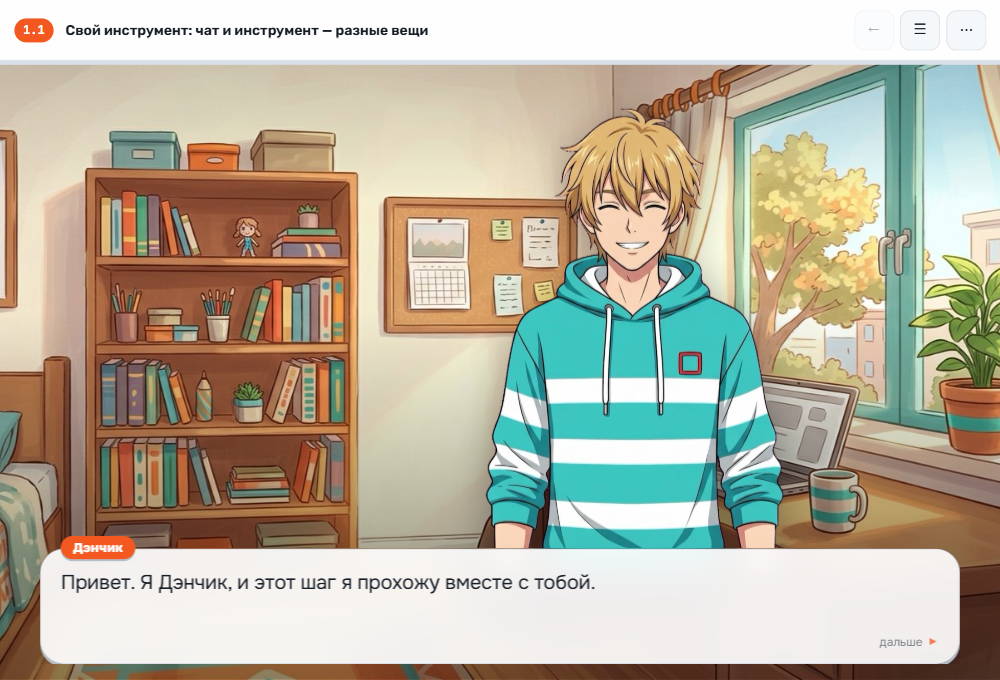
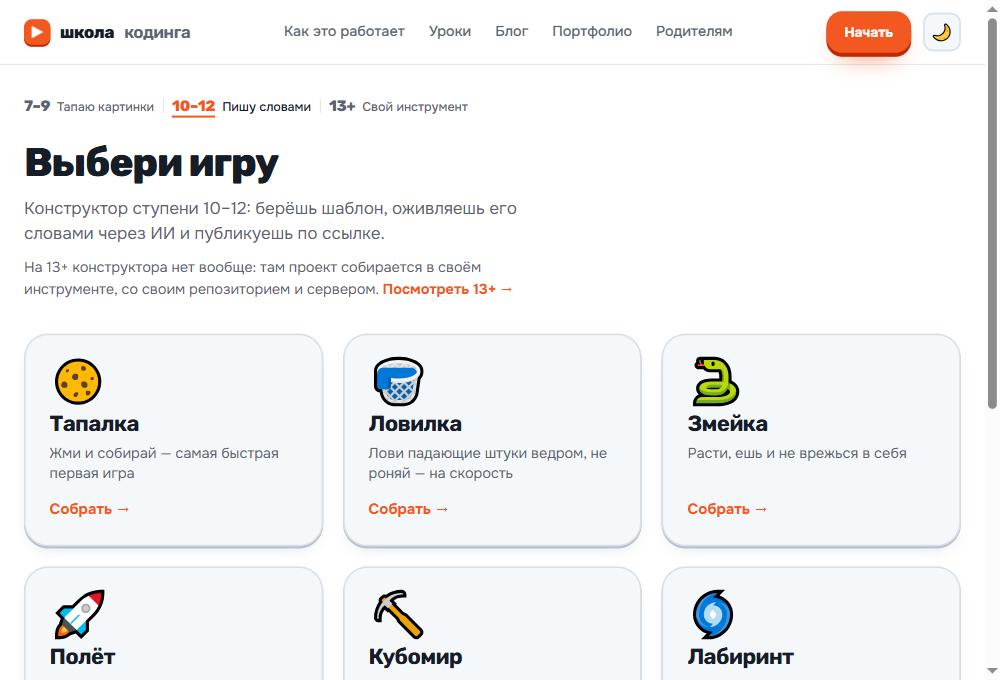
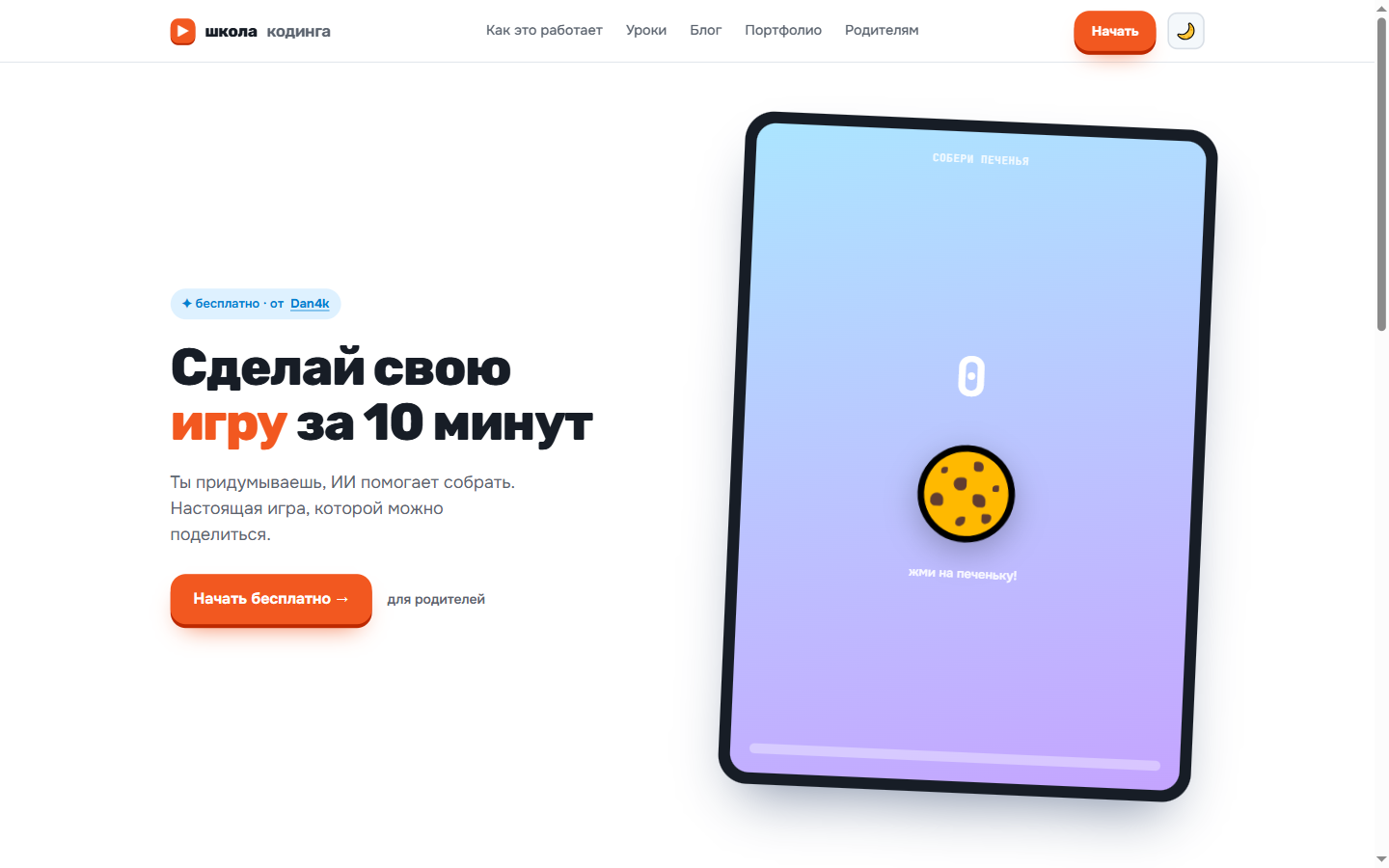
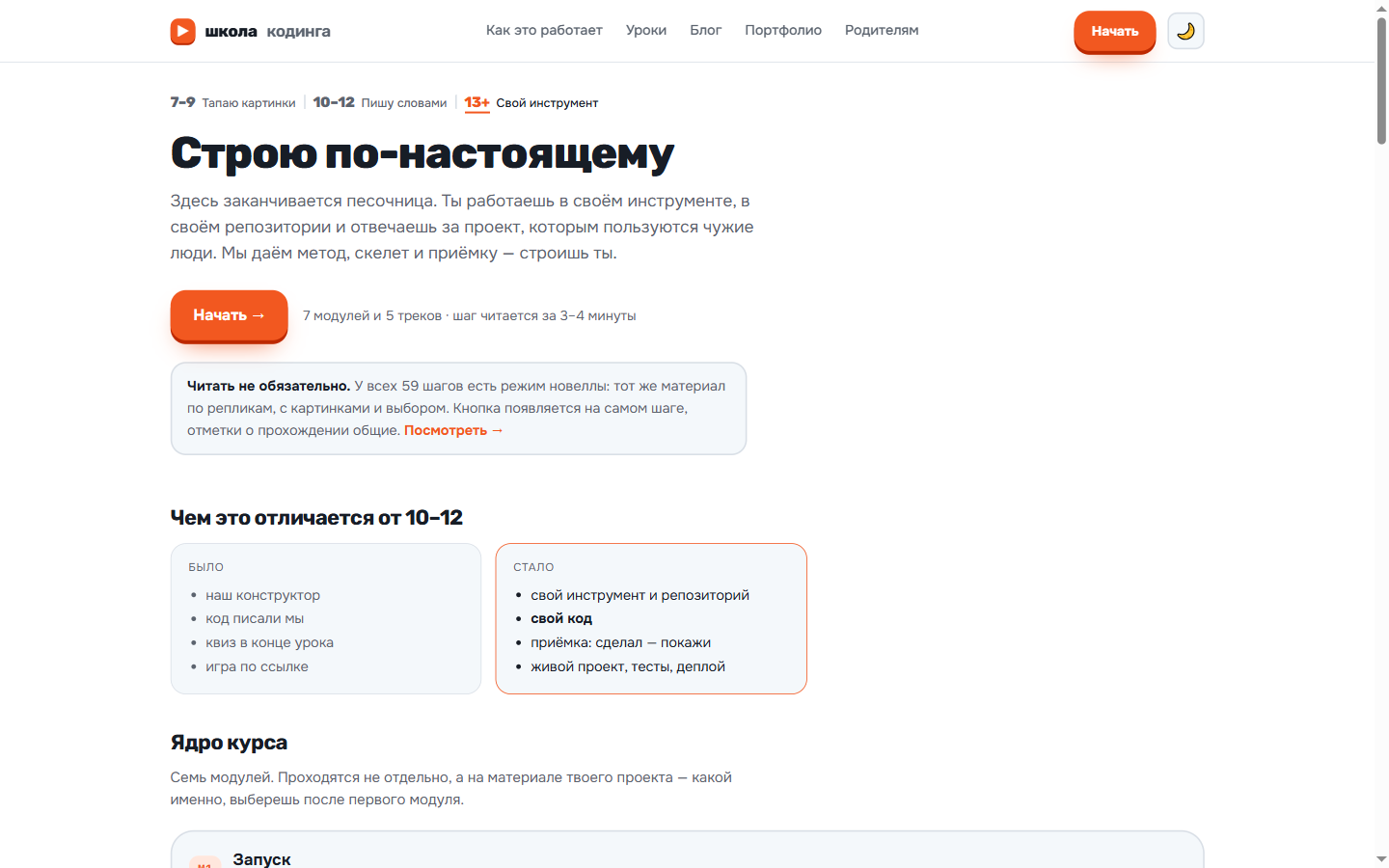
The home page, the 13+ stage with an acceptance on every step, the visual-novel mode and the game builder. The build shown is the Russian one - the English version is specified, not shipped.
The school home page
Home - three stages and a live demo game right on the first screen
The 13+ stage
Stage 13+ - 7 modules and 5 tracks: Minecraft, Roblox, Telegram, Godot, Steam
Visual-novel mode
The same lesson as a novel: backgrounds, character emotions, choices - for kids who don't read
The game builder
Builder: a template, bringing it to life in words through AI, publishing on a link

Need a product that teaches, not one that retains?

The school is my own non-commercial initiative: a free project taken from method to a live product. If you have EdTech, a service for kids, or learning inside a product, where honesty, privacy and checking the result matter more than a checkbox - in 30 minutes we'll map out how to build it so it works unattended.